 Tips for Building
Two methods, two different jobs. Liquid screed is pumped in, flows almost level on its own and wraps underfloor heating pipes, but it arrives with a lorry and a contractor. A sand and cement screed can be laid by hand across a room or two, with a straight edge, level pegs and a lot of kneeling. Either way, the edge strip, the level and the drying decide the result.
The steps, in order
Decide which screed you are laying
Bonded onto a sound, prepared base; unbonded over a membrane where the base moves or draws damp; floating over insulation where the floor has to insulate or bury heating pipes. That choice drives the thickness, the preparation and everything after it, so make it before you order anything.
Tools: tape measure, laser level
Prepare the base
A bonded screed only holds on a clean, open surface: laitance, old adhesive, plaster and paint have to come off. A rotary hammer in chisel mode deals with the hard patches, a wet and dry vacuum takes care of the dust. A bonding primer goes on afterwards if the data sheet calls for one.
Tools: SDS-Plus rotary hammer with chisel, workshop vacuum, stiff brush
Fit the edge strip and membrane
A resilient edge strip runs round the whole room and past every hard point: column, pipe, threshold. Under an unbonded screed, a polythene membrane covers the floor with lapped joints turned up the walls. A screed locked against the walls cracks as it dries and carries impact sound into the structure.
Tools: utility knife, site tape, stapler
Set the finished level
Transfer the finished level onto the walls of every room with a rotary laser, allowing for the thickness of the finish and for door thresholds. For a sand and cement screed, mortar dabs or screed rails carry that level down to the floor; for a liquid screed, tripod level pins are set to the laser before the lorry arrives.
Tools: rotary laser, tape measure, chalk line
Mix and pour
Sand and cement goes in stiff, in a steady run of small batches, mixed with a paddle for one room and in a drum mixer beyond that, then spread in bays between the rails. A single room is laid in one go, with no cold joint. Liquid screed arrives ready, goes through the hose and is poured room by room without stopping, with the contractor running the pour.
Tools: paddle mixer or drum mixer, wheelbarrow, mixing tub, straight edge
Rule off, then float or dapple
Sand and cement: the straight edge is worked back and forth along the rails, then a float closes the surface and a finishing trowel tightens it once the mortar has stiffened. On a large floor a power float saves hours on your knees. Liquid screed: the dappling bar is drawn both ways across the pour, as the supplier instructs, and nothing else is done to it.
Tools: aluminium straight edge, float, finishing trowel, dappling bar, power float
Protect it and let it dry
The first days are spent with the windows shut, out of draughts and direct sun, so the surface does not dry faster than the body of the screed and crack. A calcium sulfate screed is then sanded back if its data sheet says so. The floor finish only goes down once residual moisture has been measured, never after a drying time somebody quoted in a pub.
Tools: dust sheets, tape, moisture meter
The tools: buy or hire
| Tool | Buy or hire | Why |
|---|---|---|
| Rotary laser level Finished level | Buy | The level is set once for the whole house, and the laser comes back out for tiling and stud walls. See on Amazon |
| SDS-Plus rotary hammer Base preparation | Buy | In chisel mode it lifts an old screed, hard adhesive or laitance that nothing else shifts. See our scored comparison |
| Wet and dry vacuum Base preparation | Buy | A bonded screed will not stick to a dusty base, and a brush does not get there. See on Amazon |
| Paddle mixer Mixing | Depends on volume | Enough for one room; past that, a drum mixer saves the arms and keeps the batches coming. See on Amazon |
| Drum mixer Mixing | Depends on volume | Hire it for a one-off screed, buy it if more mixing follows on the same site. See on Amazon |
| Aluminium straight edge Ruling off | Buy | Two metres of aluminium that come back out for every levelling job and every slab. See on Amazon |
| Float and finishing trowel Finishing | Buy | Cheap, and the whole finish of a sand and cement screed happens with them. See on Amazon |
| Dappling bar Liquid screed | Hire | Needed for half a day, and usually supplied by the contractor with the pour. |
| Power float Large floors | Hire | Far too much to buy for a floor you will only ever float once. |
| Knee pads The whole pour | Buy | A screed is laid kneeling in a mortar that burns skin: this is not an accessory. See on Amazon |
Consumables
- Screed mortar in ready-mixed bags, or cement and sharp sand at the proportions the maker states.
- Liquid screed delivered and pumped, cement based or calcium sulfate based depending on the room and the damp it will see.
- Resilient edge strip round the whole perimeter and past every hard point.
- Polythene membrane under an unbonded screed, joints lapped.
- Bonding primer for a bonded screed, the one the data sheet names.
- Insulation board under a floating screed, at the resistance the design calls for.
- Mesh or fibres where the type of screed and the product ask for them.
Safety on this job
- Fresh cement burns skin. Boots, gloves, long trousers, knee pads over the top, and rinse a splash straight away.
- Chiselling dust: mask, goggles and extraction at the tool; the silica in laitance is not something to breathe.
- Handling: a day of mortar bags wrecks a back, so work in pairs and have the pallet dropped as close as it will go.
- Pumped screed: the hose whips when a blockage clears, so leave the pour zone to the contractor.
- Fresh floor: tape the room off, nobody walks across a screed that has just been ruled.
Machines we compare for this job
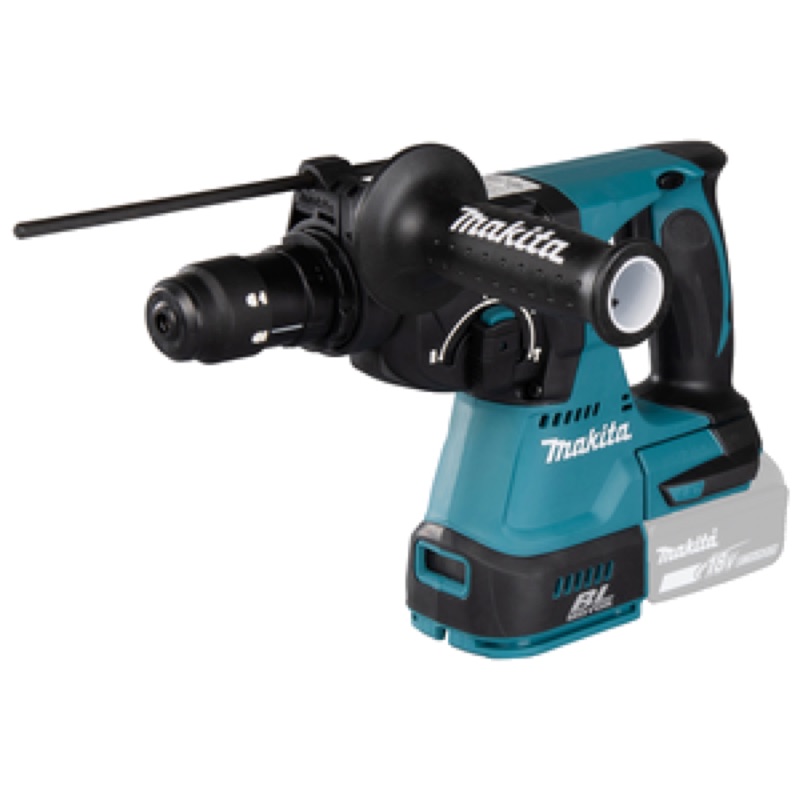
18V SDS-Plus rotary hammers
Seven 18V SDS-Plus rotary hammers, one per battery platform, scored on impact energy, capacity, hammer rate and price per joule.
See the comparisonFrequently asked questions
Liquid screed or sand and cement?
Liquid wins as soon as there is area to cover, underfloor heating to wrap without voids, or a flatness requirement. It needs a lorry, a pump, access and a contractor. Sand and cement stays workable for two people across a room or two, and takes the thin make-up depths the product allows. Compare the cost of the finished floor, delivery and labour included, not the price of a bag.
When can the tiles or the timber floor go down?
When residual moisture has been measured below the figure the finish and its adhesive require, not after a fixed number of weeks. The reading is taken on a sample from within the thickness, with a carbide meter or a hygrometer box. On a calcium sulfate screed, the limit for timber is lower than for tiles: the floor maker's instructions have the final say.
Screed or self-levelling compound?
A levelling compound makes up a few millimetres on a base that is already flat, sound and clean. As soon as you have a centimetre or more to make up, pipes to bury, insulation to cover or underfloor heating to enclose, it is a screed, with its depth and its drying time.
Is an edge strip really needed in a corridor?
Yes, round the whole perimeter and past every hard point: pipe, column, threshold, door frame. Without it the screed locks against the walls, cracks as it dries and passes impact sound into the structure. It is the cheapest item on the job and the one most often left out.