 Tips for Building
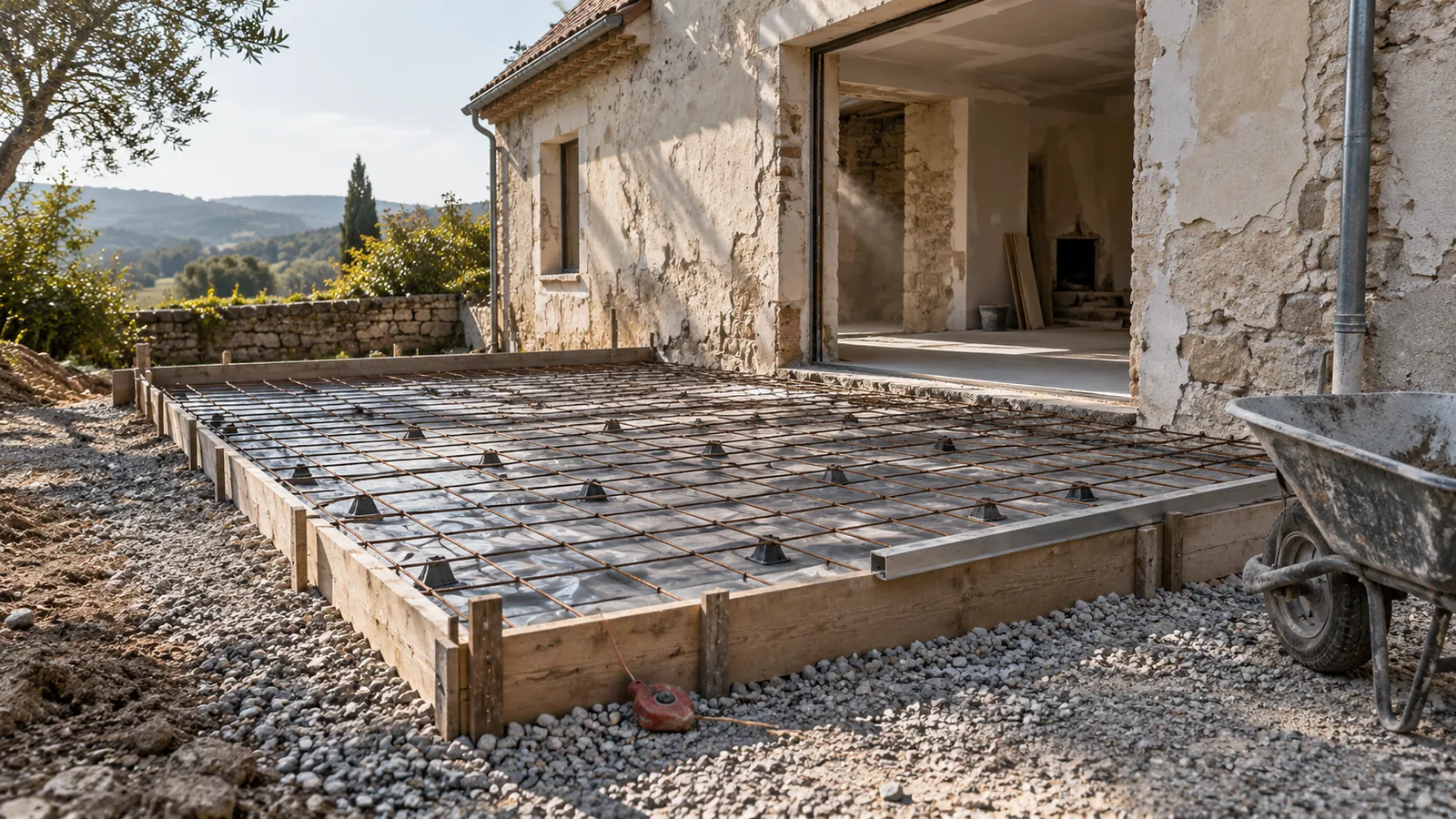
Hire the heavy machines, buy what will come back out. A mini digger, a plate compactor and a floor saw earn their keep for a day or two. The laser level, the aluminium straight edge and the angle grinder will serve on the rest of the house.
The steps, in order
Set out and dig
Mark the footprint with a string line and pegs, leaving room around it for the formwork. Strip the topsoil down to firm ground: the ground carries the slab, not the concrete.
Tools: string line, pegs, laser level, spade, a mini digger beyond a few square metres
Compact the sub-base
Spread the hardcore or crushed stone in thin layers and compact each one. A thick layer compacted in a single pass stays soft at the bottom, and the slab eventually shows it.
Tools: wheelbarrow, rake, plate compactor
Form up and set levels
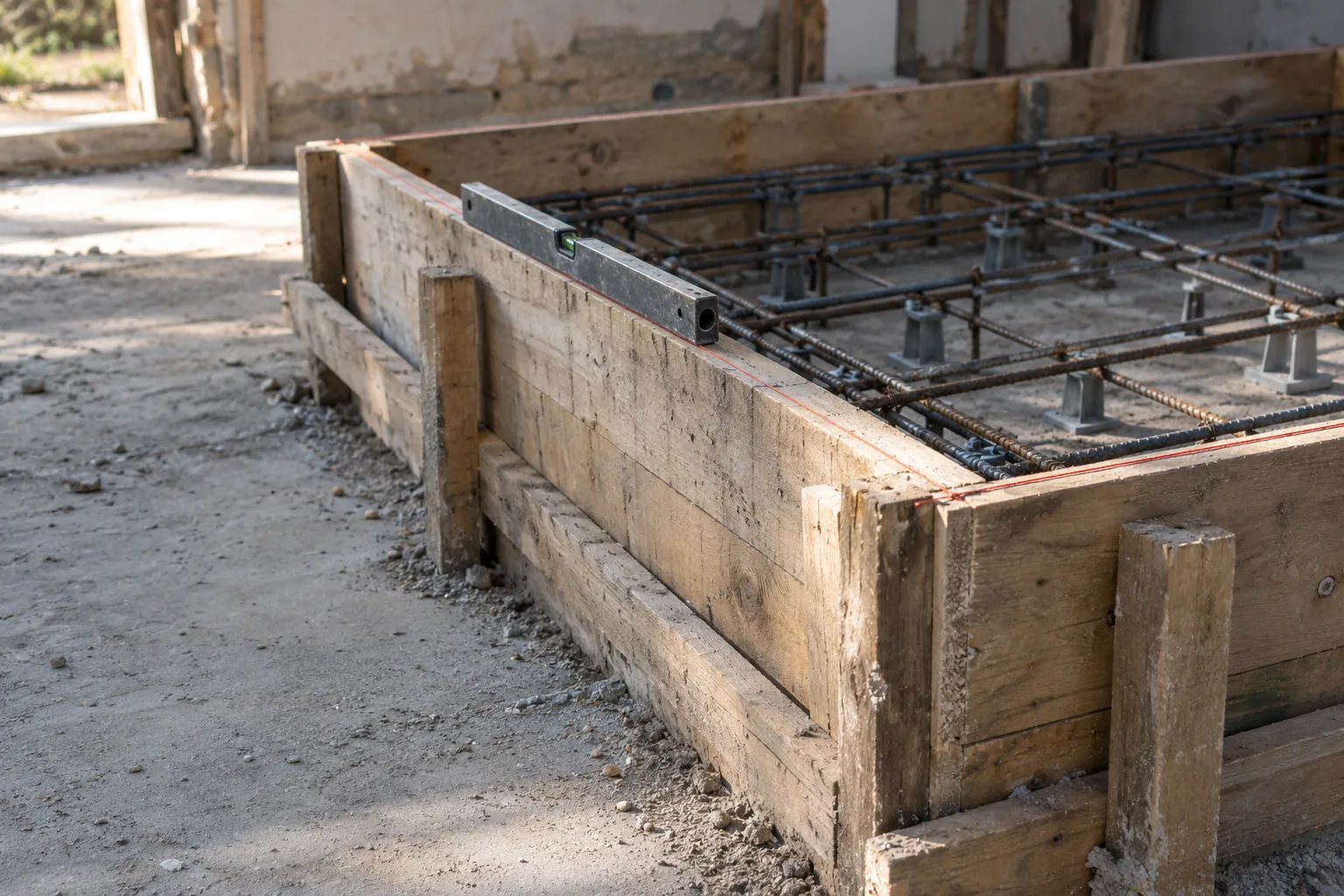
Fix the formwork boards to pegs, set to the finished height of the slab. Give a patio, or any floor that will be washed down, a slight fall towards the outside so water does not sit on it.
Tools: saw, drill driver, laser level, straight edge
Membrane and mesh
Under an indoor slab, a polythene membrane limits rising damp. Steel mesh sits on spacers, never on the ground: it only works when concrete surrounds it. Sheets overlap where they meet.
Tools: angle grinder or bolt cutters, mesh spacers
Pour in one go
Work out the volume before you order or mix, with the concrete calculator. With a mixer, keep every batch to the same mix. Beyond a few cubic metres, ready-mix delivered by truck saves a day of mixing and the cold joints between batches.
Tools: concrete mixer, wheelbarrows, shovel, a generator if the plot has no supply yet
Level and finish
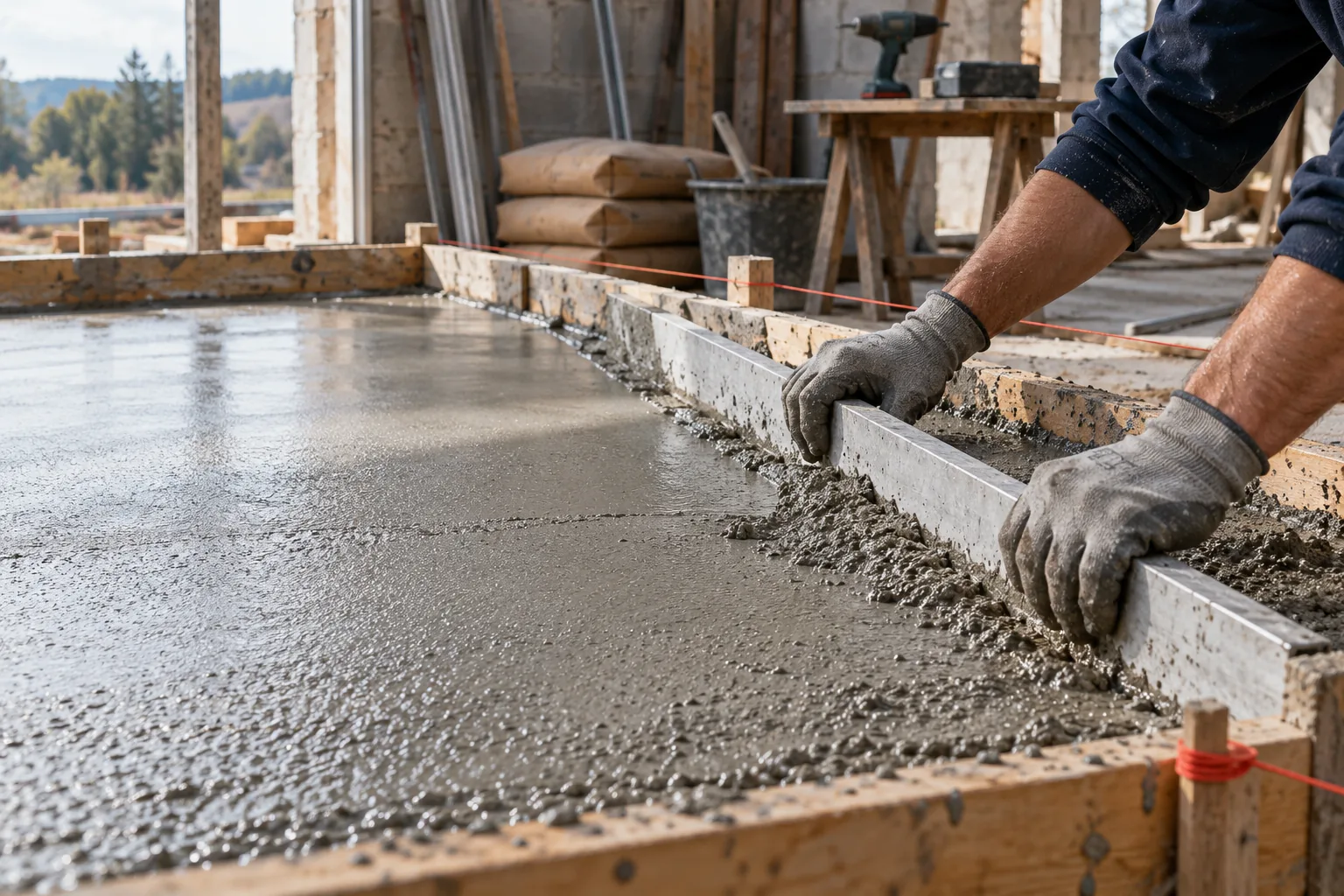
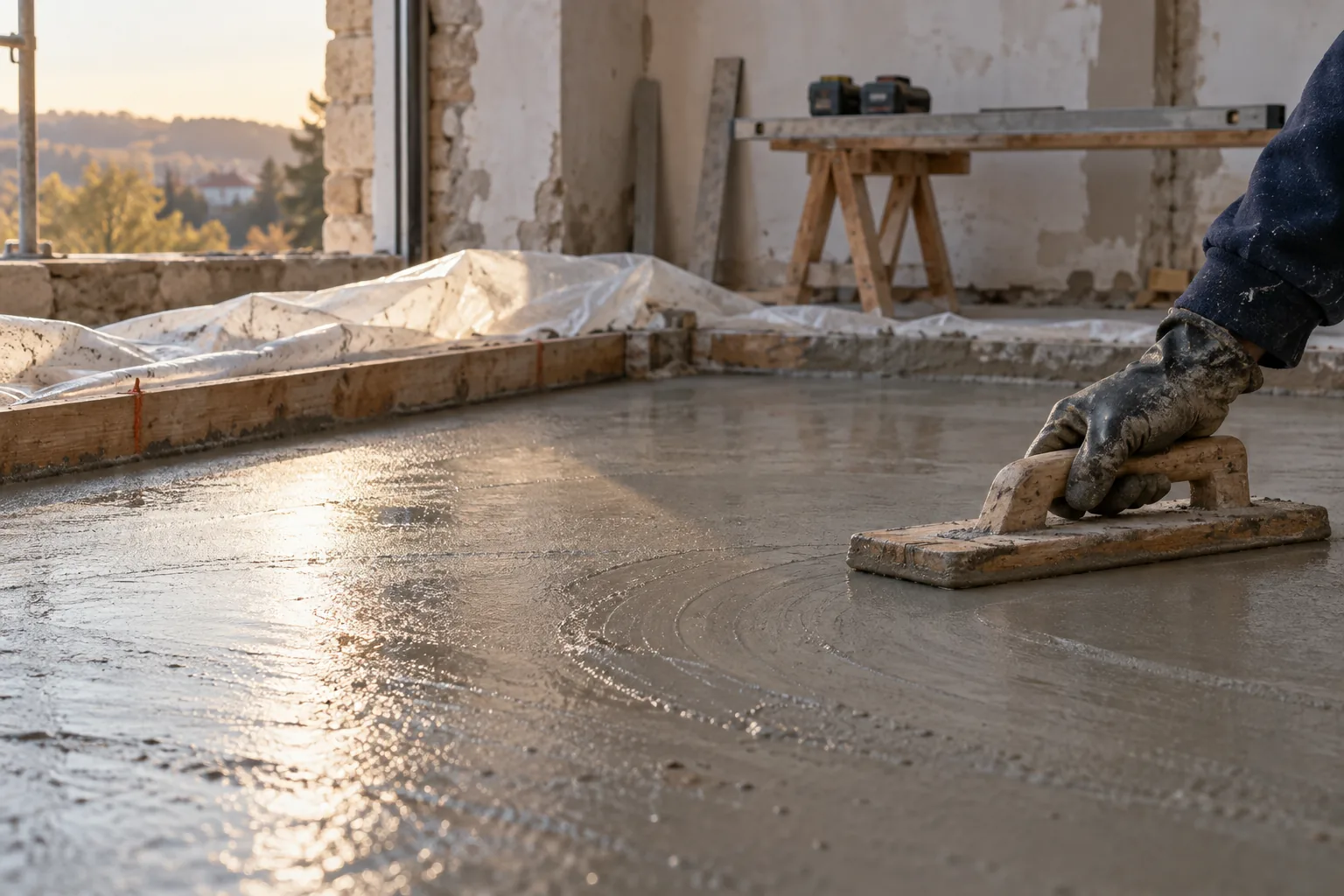
Tamp and level the concrete with a straight edge riding on the formwork, in a sawing motion. Float it once the surface water has gone, then trowel it smooth, or brush it for an outdoor surface with more grip.
Tools: aluminium straight edge, float, finishing trowel, stiff broom
Joints and curing
A large slab cracks where it pleases unless you tell it where. Control joints, sawn or formed, divide it into bays. Then keep the concrete damp and sheltered from sun, wind and frost for the first days: concrete that dries too fast loses part of its strength.
Tools: floor saw or diamond-bladed grinder, tarpaulin
The tools: buy or hire
| Tool | Buy or hire | Why |
|---|---|---|
| Laser level Setting out, formwork | Buy | It will be used again for stud walls, tiling and every second-fix job. See on Amazon |
| Mini digger Digging out | Hire | A few hours of work, for a purchase price out of all proportion. |
| Plate compactor Sub-base | Hire | Essential for a day or two, useless afterwards. |
| Circular saw Formwork | Buy | It cuts formwork boards and pegs, then comes back out for framing, OSB and decking. See our scored comparison |
| Concrete mixer Pouring | Depends on volume | Buy it if more work follows, garden walls, thresholds or screeds; hire it for a single slab; skip it if ready-mix arrives by truck. See on Amazon |
| Generator Pouring | Depends on volume | Only if the plot has no supply yet. The mixer and the grinder run together: add up their continuous power. See our scored comparison |
| Aluminium straight edge Levelling | Buy | Cheap, and it also serves for screeds and for checking a floor before tiling. See on Amazon |
| Angle grinder Mesh, joints | Buy | It cuts mesh and, with a diamond blade, the joints on a small slab. See on Amazon |
| Floor saw Joints | Hire | On a large area, straighter and faster than a grinder. |
| SDS-Plus rotary hammer Formwork, fixings | Buy | For drilling existing concrete and fixing what needs fixing; it comes back out for the stud walls. See our scored comparison |
| Pressure washer After the pour | Buy | Concrete left to set in the mixer drum, on barrows and tools only comes off with a chisel. It comes back out for the patio and the render. See our scored comparison |
Consumables
- Concrete: ready-to-use bags for a small area, cement, sand and aggregate at your chosen mix, or ready-mix.
- Hardcore or crushed stone for the sub-base.
- Polythene membrane under an indoor slab.
- Steel mesh and spacers.
- Formwork boards, pegs and release oil.
- Tarpaulin or curing compound to protect the fresh concrete.
Safety on this job
- Wet concrete burns skin. It is strongly alkaline: gloves, long sleeves and boots, and rinse at once with clean water if any reaches your eyes.
- Cutting dust contains silica. Cut wet where you can, otherwise wear a suitable respirator.
- Plate compactor and floor saw: hearing protection and safety boots.
Machines we compare for this job

18V SDS-Plus rotary hammers
Seven 18V SDS-Plus rotary hammers, one per battery platform, scored on impact energy, capacity, hammer rate and price per joule.
See the comparison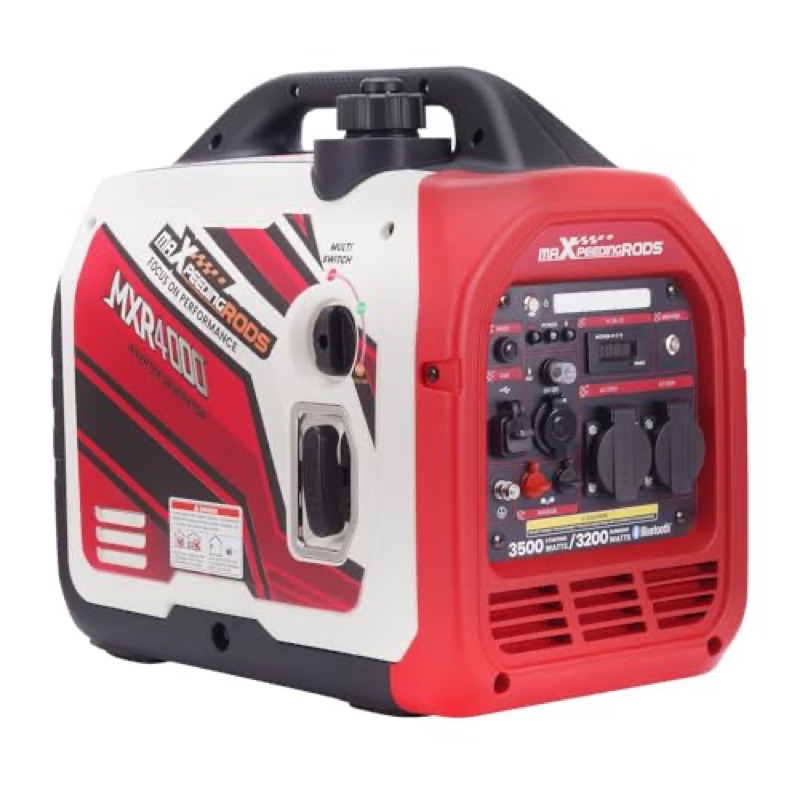
Inverter generators
Eight 230 V inverter generators from 1.6 to 3.2 kW compared on continuous power, noise at 7 metres, weight and price per kW, with the scoring formula and the measurement traps.
See the comparison
Pressure washers
Eleven pressure washers scored on rated pressure and flow, not the maximums on the box: hydraulic power, price per kW, noise, weight and hose length.
See the comparison
Circular saws
Eleven 184 to 190 mm circular saws scored on cutting depth at 90° and 45°, price, noise and weight, with the inconsistencies in their spec sheets flagged.
See the comparisonFrequently asked questions
How thick should a patio or shed base be?
For a patio or a garden shed with no heavy load, 100 to 120 mm of concrete with mesh is common; for a garage that takes a car, more like 120 to 150 mm on a well compacted sub-base. Those figures assume stable ground. If you have any doubt about the ground, professional advice is worth more than a few extra millimetres of concrete.
Should I buy or hire a concrete mixer?
For a single slab, hire one, and beyond a few cubic metres ready-mix by truck is often simpler. Buying makes sense when more work follows: garden walls, thresholds, screeds, bedding posts.
When can I walk on a new slab?
Usually with care after a day or two. A car waits several weeks: concrete reaches most of its strength at around 28 days, and cold weather slows everything down.