Tips for Building
The highest score · The best price per l/min
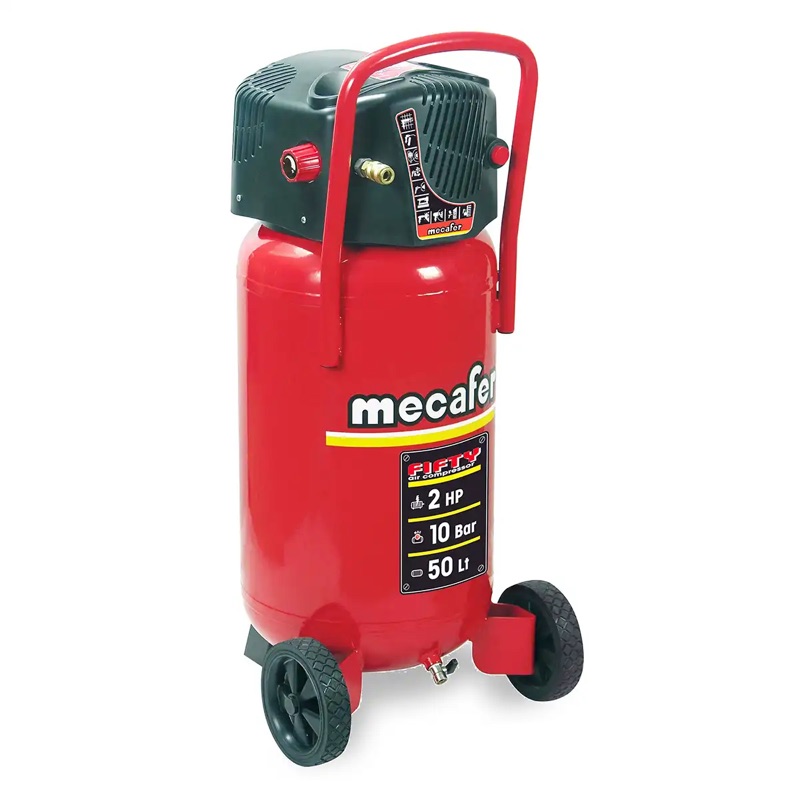
Mecafer Fifty 50 L
8.5/10
score calculated from published figures
The highest stated delivery, and the lowest price per litre
Scored comparison
A nailer, a blow gun, a spray gun, the wheelbarrow tyre: on a self-build site the compressor gets used every day. The big number printed on the tank is not the air your tool receives.
Affiliate link: we earn a commission if you buy through it, at no extra cost to you. It never affects our scores. How we make money
The highest score · The best price per l/min
8.5/10
score calculated from published figures
The highest stated delivery, and the lowest price per litre
Second-highest score
7.5/10
score calculated from published figures
The best balance of air and noise
Compare delivered air, not intake. The headline figure, 220 or 240 l/min, is the air the pump draws in. At 7 bar the tool gets roughly a third of it: 60 to 104 l/min for five of the six scored machines here. That delivered figure is the one to set against the consumption printed on your tool.
8 of 8 machines
| Machine | Score | Air delivered at 7 bar | Retrieved price |
|---|---|---|---|
| 8.5/10 | 126 l/min | $173.84See on Amazon | |
| 7.5/10 | 104 l/min | $291.60See on Amazon | |
| 6.5/10 | 60 l/min | $122.24See on Amazon | |
| 6/10 | 98 l/min | $376.80See on Amazon | |
| 6/10 | 76 l/min | $203.66See on Amazon | |
| 5.5/10 | 65 l/min | $167.11See on Amazon | |
| Not scored: too few figures | not published on the page we consulted | $257.96See on Amazon | |
| Not scored: too few figures | not published on the page we consulted | $246.74See on Amazon |
No item matches these filters.
We have not run any of these machines, and we do not present anything as if we had. The score comes from four measurable criteria: air delivered at 7 bar 40 percent, price per delivered l/min 25 percent, sound power LwA 20 percent, weight 15 percent. Each value is placed on a 4 to 10 scale against the other machines in the panel.
When a maker does not publish a figure, or publishes it ambiguously, that criterion drops out and the remaining weights are renormalised. Below 60 percent of the scale, or without air delivered at 7 bar, no score is calculated. Two machines are in that position, and their pages say why.
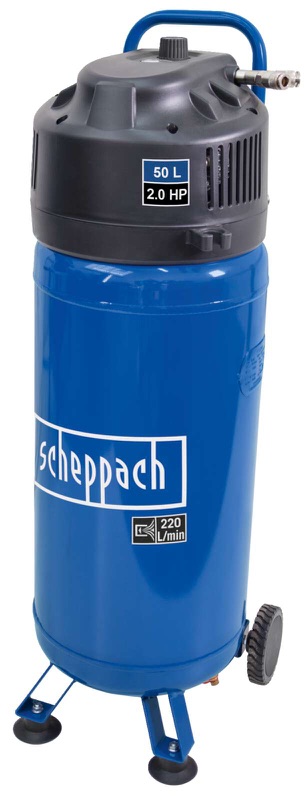
A compressor nearly always advertises its intake: the air the pump draws in, measured at no pressure. Once that air is compressed to 7 bar, far less is left. In this panel, delivered air is 27 to 36 percent of intake for five machines out of six. The Scheppach HC51V draws 220 l/min and delivers 65.
The Mecafer Fifty is the exception: 126 l/min delivered from 230 drawn in, or 55 percent. That is the figure Mecafer publishes on its page and its datasheet, and we use it as published. It puts this model top of the ranking. If you buy it for that figure, bear in mind how far it stands from the rest.
Makers do not all measure at the same pressure either. Metabo quotes its effective delivery at 80 percent of maximum pressure, which is 6.4 bar on an 8 bar machine. The lower the pressure, the more flattering the flow: that figure does not compare with a 7 bar one, and we do not score it.
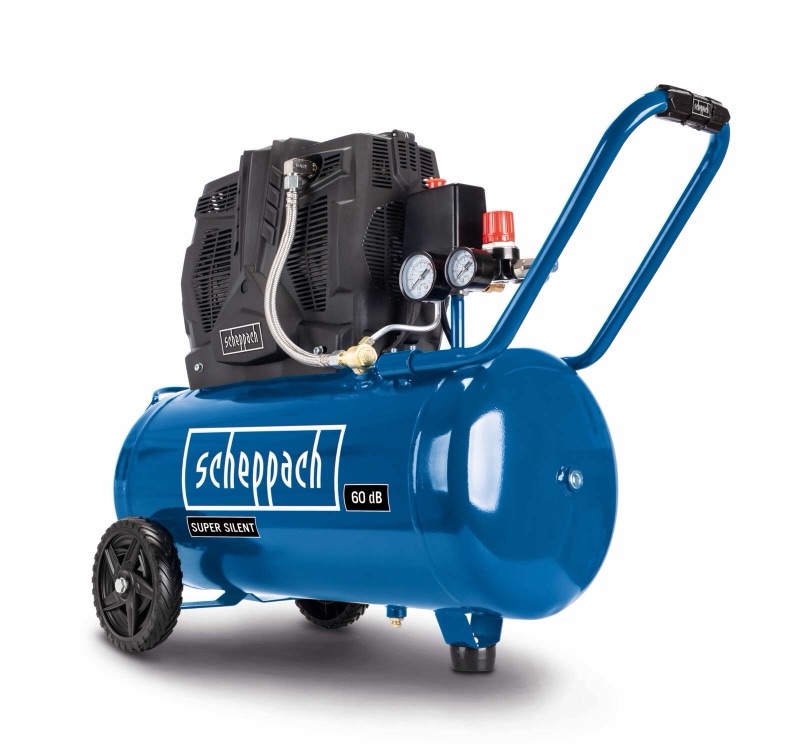
Guaranteed sound power LwA appears on the label European rules require on compressors. It is the only noise figure we score. Sound pressure, often printed large on the tank, depends on distance and load: the Scheppach HC51Si's 60 dB(A) is measured at 7 metres and 25 percent load, and its guaranteed sound power is 87 dB(A).
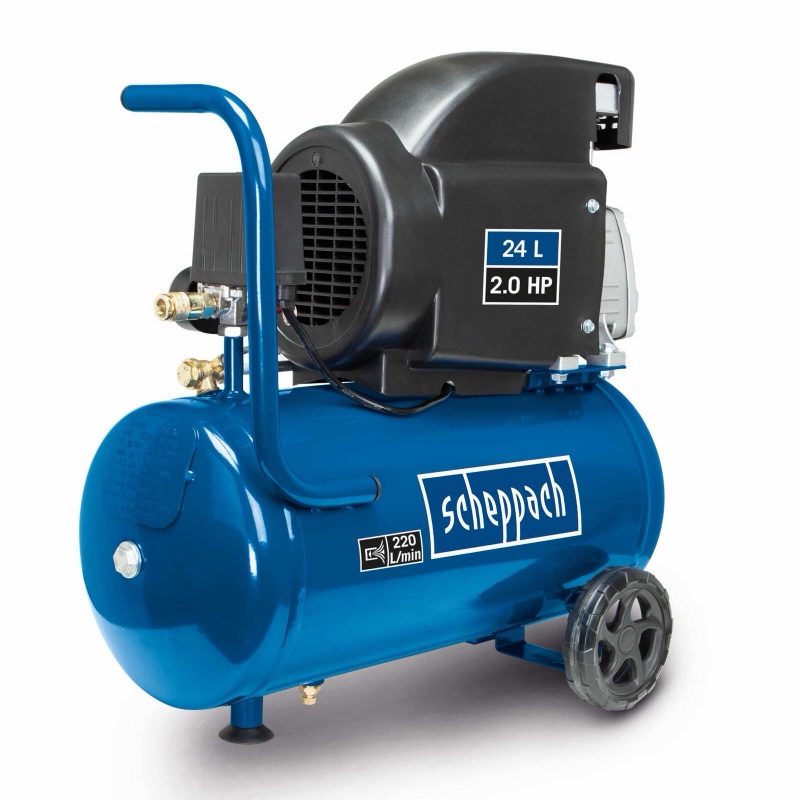
The tank is a reserve, it does not increase air delivery. A 24 litre machine is enough for a nailer, a blow gun and inflating, and it is easy to store and carry. A 50 litre tank lets the motor rest longer between cycles, which matters for spray painting or long sessions.
An oil-free compressor needs no oil changes and can lie flat in a car boot. An oil-lubricated one needs its oil level checked and travels upright. In this comparison, only the Scheppach HC26 is lubricated.
Generally not. Those tools use air continuously, with no pause for the tank to refill. Compare their stated consumption with delivered air at working pressure: with 60 to 126 l/min delivered, these machines are built for intermittent tools such as a nailer, a blow gun, inflating or occasional spray painting.